Patina · Materials
Materials
Every metal reacts differently to air and moisture. What becomes of it is decided when the material is chosen, long before the colour.
The metal that changes colour over the years
Bare copper forms an oxide film in the air within hours, one the eye cannot yet see. Over months the surface loses its shine and turns an even brown, over years that brown deepens towards an anthracite brown. On vertical surfaces this is usually the final state.
On pitched roofs it goes further. Because precipitation stays there longer, the basic copper compounds form that make up the familiar patina green. Depending on location and rainfall that takes roughly eight to fifteen years.
Sequence and time span according to information print i.30 of the German Copper Institute.
Copper with zinc, and that changes everything
Brass is an alloy of copper and zinc, with usual zinc contents between five and forty five per cent. The zinc content determines the colour: gold red at low content, full yellow at medium, pale yellow at high. European standards list around sixty grades of brass.
In the air brass darkens, but differently from copper. It moves towards brown and grey brown tones, and a closed green layer forms far more slowly and far more rarely. The process we use to darken brass deliberately is called burnishing.
Figures on composition, colour range and number of grades according to the German Copper Institute.
Darker and quieter than brass
Bronze is a copper alloy as well. On buildings it appears above all as facade cladding and in interiors. Two examples from our production: the vertical bronze facade of the Joseph Pschorr House in Munich and the perforated wall cladding at the Mozarteum in Salzburg.
The material that stays as it is
Stainless steel forms no coloured layer of its own. It does not change in the air, and that is often exactly why it is chosen. Its effect comes from the way the surface is worked, not from a reaction with its surroundings.
Four tones are available from us: Light, Dark, Light Brass and Dark Brass.
Rust that protects instead of destroying
Weathering steel forms a firmly adhering layer of rust in the air that shields the material underneath. It therefore follows the same principle as patina on copper: the metal transforms at the surface and protects itself in doing so. The result is a warm rust brown that deepens over the years.
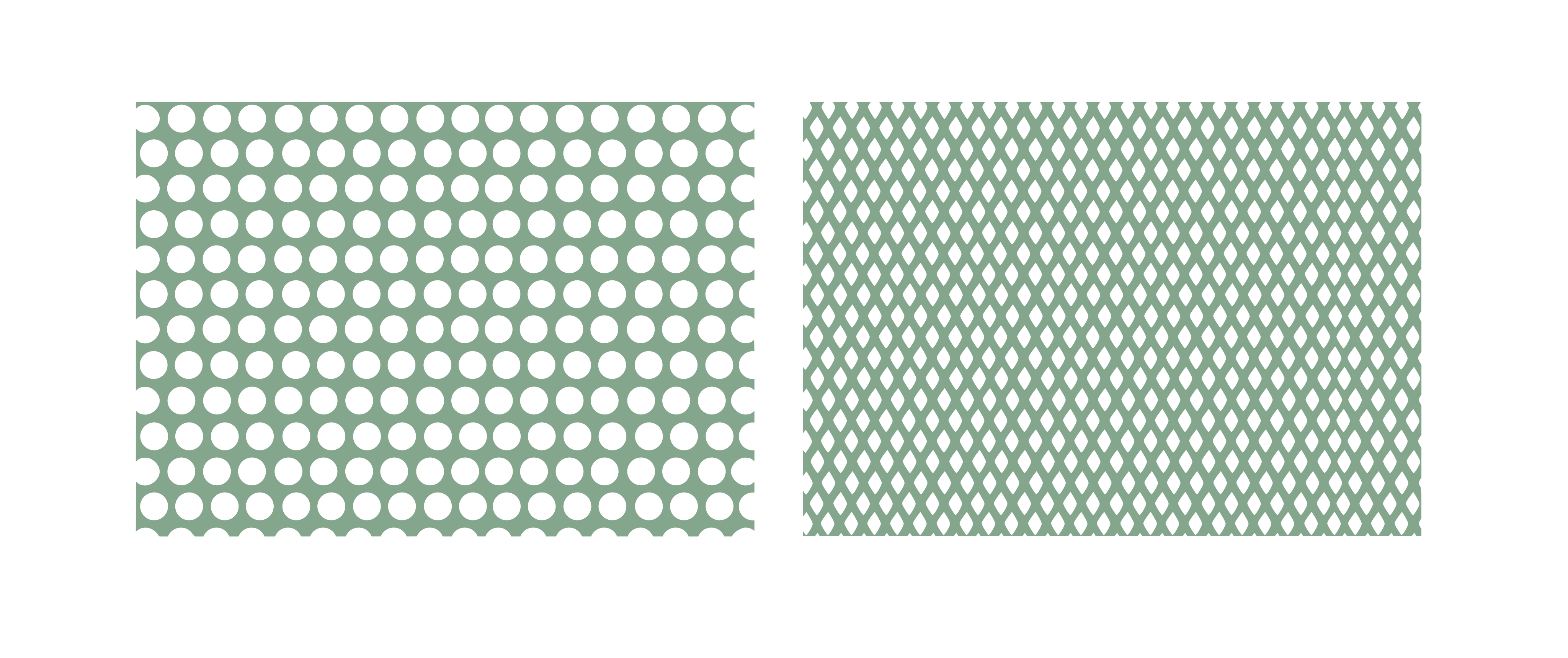
Perforated and expanded too
Patina does not require a solid sheet. Perforated sheet and expanded metal take the finish just as well, and on both it behaves differently from a flat surface: light passes through, the shadow edge takes on a colour of its own, and the surface changes with the viewing angle.